Blockchain Development Services: A Complete Guide for Businesses Building on Web3
Blockchain has moved past the hype cycle. What started as the technology behind Bitcoin is now powering supply chain tracking, cross-border payments, healthcare records, real estate contracts, and loyalty programs for businesses that have nothing to do with cryptocurrency. If you’re evaluating blockchain development services for your business, this guide covers exactly what that means, what to expect from a development partner, and how to choose one that fits your project — whether you’re in India, the US, or the UK.
What Is Blockchain Technology, in Plain Terms?
Think of blockchain as a shared record book that many people can view and verify, but no single person can secretly edit. Every entry (or “block”) is linked to the one before it and distributed across a network of computers rather than stored on one central server. That structure is what makes blockchain valuable for business: no single point of failure, no silent edits, and a transparent trail that all parties can trust without needing to trust each other directly.
For a business, that translates into three practical benefits: stronger data integrity, reduced dependency on middlemen, and verifiable transaction history — useful in finance, logistics, healthcare, real estate, and anywhere trust between parties has traditionally required a costly intermediary.
What Do Blockchain Development Services Actually Include?
“Blockchain development” isn’t one service — it’s an umbrella covering several distinct capabilities. A competent development partner should be able to support most of the following:
1. Smart Contract Development
Smart contracts are self-executing agreements written in code — when conditions are met, the contract runs automatically, with no manual approval needed. This is the backbone of almost every blockchain application, from payment release to loyalty rewards to escrow. Good smart contract work focuses heavily on security auditing, since a flaw here can be exploited directly.
2. Decentralized Application (dApp) Development
A dApp looks and feels like a normal web or mobile app, but its backend logic runs on a blockchain instead of a centralized server. Businesses use dApps for everything from decentralized finance tools to supply chain dashboards to gaming platforms.
3. Crypto Wallet Development
Wallets are how users store, send, and receive digital assets. Development here includes integrating with existing wallets (MetaMask, Trust Wallet, WalletConnect) or building a custom wallet with tailored security and UX for a specific platform.
4. NFT Development
Non-fungible tokens represent unique digital or digitized physical assets — art, collectibles, certificates, real estate deeds, even loyalty points. NFT development covers token creation, marketplace platforms, and the smart contracts that govern ownership and transfer.
5. Tokenization
Tokenization converts real-world assets or rights — property, equity, revenue shares — into digital tokens on a blockchain, making them easier to divide, trade, and track. This is increasingly used in real estate and private equity to unlock liquidity that traditional paperwork can’t offer.
6. DeFi (Decentralized Finance) Development
DeFi platforms let people lend, borrow, and trade without a traditional bank as intermediary. Development here involves liquidity pools, lending protocols, and yield mechanisms, all governed by audited smart contracts.
7. Blockchain Integration for Existing Systems
Not every business needs a blockchain built from scratch. Many need blockchain layered into an existing system — for example, adding a verifiable audit trail to a supply chain platform or a payment system, without rebuilding the whole application.
Which Blockchain Platforms Matter?
Platform choice depends entirely on the use case, not brand familiarity. A few common decision points:
- Ethereum — the most established ecosystem for smart contracts and dApps, with the largest developer community and tooling support.
- Polygon — an Ethereum-compatible layer-2 network chosen for lower transaction fees and faster confirmation, popular for consumer-facing apps.
- Solana — built for high throughput and low latency, often chosen for gaming and high-frequency trading applications.
- Hyperledger — a permissioned framework favored by enterprises that need blockchain benefits without full public visibility, common in supply chain and healthcare.
- Binance Smart Chain — a lower-cost alternative to Ethereum with strong exchange integration.
A capable development partner won’t push a single platform by default — the right recommendation depends on your transaction volume, privacy needs, budget, and target users.
Industries Actively Using Blockchain Development Services
Blockchain adoption today spans far beyond crypto-native companies:
- FinTech — cross-border payments, DeFi lending, fraud-resistant transaction records
- Supply Chain & Logistics — end-to-end product tracking and provenance verification
- Healthcare — tamper-proof patient records and secure data sharing between providers
- Real Estate — tokenized property ownership and transparent title records
- Retail & eCommerce — loyalty programs, counterfeit prevention, and transparent sourcing
- Gaming — true ownership of in-game assets that can be traded across platforms
- Government & Public Sector — identity verification and public record transparency
How to Choose a Blockchain Development Partner
This is where most businesses get stuck — the technology is unfamiliar, and marketing language across vendor websites tends to sound identical. A few criteria actually separate strong partners from weak ones:
Security-first development practices. Smart contracts are immutable once deployed — a bug isn’t a quick patch, it’s often a permanent vulnerability. Ask specifically about their audit process, not just whether they “test” code.
Platform-agnostic recommendations. If a provider recommends the same blockchain for every project regardless of use case, that’s a signal they’re optimizing for their own expertise rather than your requirements.
Real project experience, not just theory. Blockchain has a lot of conceptual marketing content online. Ask for specific examples of smart contracts deployed, dApps shipped, or tokenization projects completed — not just service descriptions.
Clear post-launch support. Blockchain systems, especially those handling live transactions or assets, need ongoing monitoring, especially in the early weeks after launch when usage patterns reveal edge cases.
Regulatory awareness. If you’re building anything involving tokens, security offerings, or financial transactions, your development partner should understand — or work alongside legal counsel who understands — the compliance landscape in your target market (SEC considerations in the US, FCA guidance in the UK, or RBI’s evolving stance in India).
A Practical Development Process
Regardless of the specific blockchain service, a sound development process typically follows these stages:
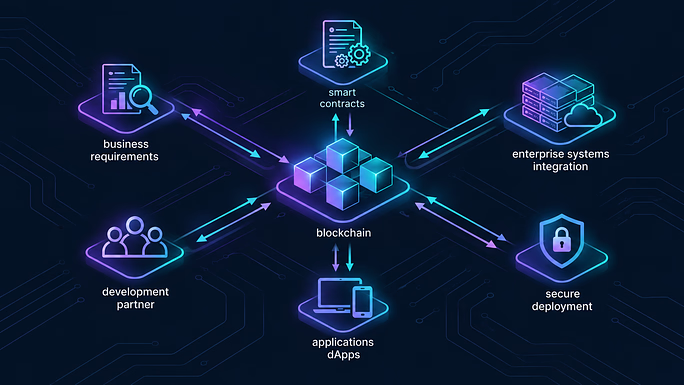
- Discovery and requirements gathering — understanding the business problem before choosing any technology.
- Solution design and architecture — selecting the right blockchain, token model, and smart contract structure.
- Development and integration — building the smart contracts, front-end, and any connections to existing systems.
- Security auditing and testing — this stage deserves as much time as development itself, given the cost of post-deployment fixes.
- Deployment and launch — going live, often on a testnet first before mainnet deployment.
- Monitoring and maintenance — ongoing oversight, since blockchain systems handling real value require continuous attention.
Skipping or rushing any of these stages — especially security auditing — is the most common reason blockchain projects run into trouble after launch.
Why Work With Ideas2goal for Blockchain Development
Ideas2goal approaches blockchain development the same way it approaches all software work: consulting-first, not template-first. Rather than pushing a fixed blockchain stack, the process starts with understanding whether blockchain is actually the right solution for your problem — sometimes it is, sometimes a well-designed traditional database with better auditing solves the same problem at a fraction of the cost and complexity.
For businesses that do need blockchain, Ideas2goal provides:
- Smart contract development and security-focused auditing
- Custom dApp development across Ethereum, Polygon, and other major networks
- Crypto wallet integration and custom wallet builds
- NFT platform and tokenization development
- Blockchain integration into existing enterprise systems
- Ongoing post-launch monitoring and support
As an India-based team serving clients across India, the US, and the UK, Ideas2goal structures engagements with overlapping working hours and clear communication practices so distance never becomes a bottleneck on a project where precision matters this much.
Frequently Asked Questions
How much does blockchain development cost? Costs vary widely based on scope — a basic smart contract deployment costs far less than a full dApp with wallet integration and a custom token model. Get a defined-scope quote rather than a broad estimate; blockchain projects are especially sensitive to scope creep.
Do I need my own blockchain, or can I build on an existing one? The vast majority of business use cases don’t need a custom blockchain — building on Ethereum, Polygon, or a permissioned framework like Hyperledger is faster, cheaper, and more secure than building infrastructure from scratch.
How long does a typical blockchain project take? A single smart contract might take a few weeks. A full dApp with wallet integration, testing, and security audits typically runs two to six months depending on complexity.
Is blockchain development only relevant for crypto businesses? No. Supply chain tracking, healthcare records, real estate tokenization, and loyalty programs are all active use cases for businesses with no connection to cryptocurrency trading.
What’s the biggest risk in a blockchain project? Unaudited or poorly tested smart contracts. Because blockchain transactions are typically irreversible, a security flaw discovered after launch is far more costly to fix than in traditional software.
Final Thoughts
Blockchain development services span a wide range — from a single smart contract to a full decentralized application ecosystem. The right starting point isn’t picking a platform or a token model; it’s identifying whether blockchain actually solves your business problem better than the alternatives, then working with a partner who can be honest about that before writing any code. That consulting-first approach is what Ideas2goal brings to every blockchain engagement, whether the client is a startup in India or an enterprise in the US or UK.