
Blockchain development services: how to choose the right development partner
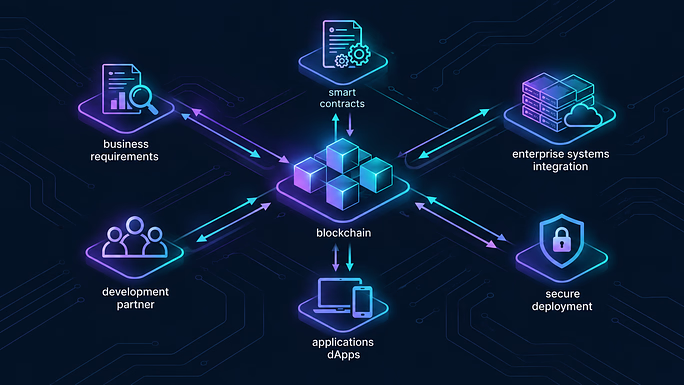
A blockchain project can look straightforward from the outside. Choose a blockchain, build the application, deploy the smart contracts, and launch.
That is usually the easy part.
The harder decision comes before development starts. Does the business actually need blockchain? What should be built on-chain and what should stay off-chain? Is an existing network enough, or does the project really require custom blockchain development? Which platform makes sense? What should the project cost? And perhaps most importantly, can the development partner explain the answers without turning every conversation into a pitch for whatever technology they already know?
For a US business owner, founder, CTO, or technology decision-maker, these are not theoretical questions. A blockchain project can involve significant development costs, security risks, integration work, and long-term technical commitments.
That makes choosing blockchain development services less about finding developers and more about finding a partner who can make sound technical decisions in partnership with the business.
At Ideas2Goal, that distinction is important. The starting point should always be the business problem, not the blockchain.
Before choosing blockchain development services, ask whether you need blockchain at all
This is the question that tends to get skipped because it does not lead directly to a development proposal.
Blockchain can be useful when several independent parties need to share or verify transactions, when ownership needs to be represented digitally, when business rules need to be executed through smart contracts, or when a system benefits from a transaction record that is not entirely controlled by one organization.
It can make sense for areas such as:
- Digital asset ownership
- Tokenization
- Smart contract-based transactions
- Decentralized applications
- Multi-party transaction management
- Digital identity and credential verification
- Asset tracking and provenance
- Cross-organization settlement
But if a business owns the database, controls access to it, and has no real need for decentralized verification, putting that application on a blockchain may add complexity without adding much value.
That is why one of the most useful questions to ask a blockchain development company is surprisingly simple:
“Would you build this without blockchain if you were making the decision for us?”
The answer tells you a lot.
A development partner that is willing to recommend a conventional database, a centralized application, or a hybrid architecture when appropriate is usually thinking about the business rather than trying to sell a blockchain project.
Blockchain development is not one type of project
Another common mistake is treating “blockchain development” as if it describes a single service. It does not.
A company may be looking for smart contract development, a decentralized application, blockchain integration, token development, enterprise blockchain development, or a completely custom blockchain network.
Those projects have very different technical requirements.
Smart contract development
This is appropriate when business logic needs to execute on-chain. Depending on the application, that could involve asset ownership, token transfers, payments, automated transactions, or other programmable rules.
Decentralized application development
A dApp typically combines a user-facing application with blockchain infrastructure and smart contracts. Wallet connectivity, transaction handling, user experience, and backend integrations all contribute to the development effort.
Blockchain integration
For an established business, this may be more relevant than building a new blockchain application from scratch.
The project could involve connecting blockchain infrastructure with existing databases, payment systems, APIs, ERP platforms, identity systems, or other enterprise applications.
Token development
Tokenization can involve much more than creating a token contract. The business model, ownership structure, transfer rules, wallet interactions, security, and regulatory considerations all need to be considered.
Enterprise blockchain development
Some organizations need controlled participation, permissioned access, privacy, governance, or integration with existing enterprise systems. Those requirements can lead to a very different architecture from a public blockchain application.
Custom blockchain development
Building a network of your own is a much bigger commitment. Unless an existing blockchain cannot meet an important requirement, creating a new protocol or network can introduce complexity the business may not need.
The point is simple: before comparing blockchain development companies, define what kind of blockchain problem you are actually trying to solve.
The most important architectural decision may be what does not go on the blockchain
There is a tendency in blockchain projects to assume that everything should be stored or executed on-chain. That is rarely the best architecture.
A production application may have a blockchain layer alongside conventional databases, APIs, cloud infrastructure, authentication systems, analytics, and business applications.
The development partner needs to determine where each piece belongs.
For example, an application may use smart contracts to establish ownership or execute a transaction while keeping large amounts of application data in an off-chain database.
That can affect:
- Performance
- Transaction costs
- Privacy
- Scalability
- Data management
- Security
- Application responsiveness
This is where architecture experience becomes more valuable than simply having developers who know Solidity.
When evaluating a blockchain development service, ask the team to walk through the proposed architecture and explain why certain data and processes are on-chain while others are not.
If the answer is unclear, the project probably is not ready for development.
Ethereum, Polygon, Solana or Hyperledger? Start with requirements
There is no blockchain that is automatically right for every business.
- Ethereum may make sense when ecosystem maturity, smart contract compatibility, decentralization, and access to established infrastructure are important.
- Polygon can be considered when Ethereum ecosystem compatibility is useful, but the project has different requirements around transaction economics, scalability, or deployment architecture.
- Solana may be relevant for applications where transaction throughput and transaction costs are particularly important.
- Hyperledger is a different proposition altogether. Enterprise teams evaluating Hyperledger are often dealing with permissioned participation, organizational governance, privacy, and controlled network access rather than the characteristics of a public blockchain.
The mistake is choosing the blockchain first and then shaping the project around it.
A better sequence is:
Business requirement → technical requirements → architecture → blockchain selection
Not:
Developer expertise → preferred blockchain → project architecture
A capable blockchain development partner should be comfortable explaining why one option is better than another and where the compromises are.
That last part matters.
There is no technology decision without trade-offs.
Should you build on an existing blockchain or create your own?
For most businesses, building on an established network deserves serious consideration before custom blockchain development.
Creating a blockchain from scratch means taking responsibility for much more than application development. Network architecture, consensus, validators, cryptography, governance, upgrades, node infrastructure, monitoring, security, and long-term maintenance all become part of the technology strategy.
There are situations where that level of control makes sense.
For example, an organization may have requirements related to network governance, permissioning, transaction processing, privacy, or a specialized operating model that existing networks cannot effectively accommodate.
But “custom” should not be treated as a synonym for “enterprise-grade.”
Sometimes the better solution is an existing blockchain. Sometimes it is a Layer 2 solution. Sometimes it is a permissioned network. And sometimes blockchain should not be part of the architecture at all.
A development partner should be able to make that distinction before the development team starts billing hours.
What should blockchain development services cost?
This is one area where giving businesses a single number is misleading.
A smart contract and dApp integration is not comparable to a complex enterprise blockchain platform. A tokenization project with multiple integrations is not comparable to a proof of concept.
Cost depends on the actual scope, including:
- Smart contract complexity
- Blockchain platform
- Frontend and backend development
- Wallet integration
- APIs and third-party integrations
- Token functionality
- Security requirements
- Testing
- Infrastructure
- Compliance requirements
- Number of supported platforms
- Post-launch maintenance
The better question is not simply:
“How much does blockchain development cost?”
Ask:
“What exactly is included in the estimate?”
A serious proposal should make the assumptions visible.
For example:
- Does the quote include architecture?
- QA?
- Smart contract security testing?
- Deployment?
- Cloud infrastructure?
- Monitoring?
- Post-launch support?
- What happens if requirements change?
Two blockchain development companies can quote very different amounts for what appears to be the same project because they are actually pricing different scopes.
A lower initial quote does not necessarily mean a lower project cost.
How long does blockchain development take?
The same principle applies to timelines.
A proof of concept can move relatively quickly. A production system involving complex smart contracts, external integrations, security testing, infrastructure, and compliance requirements is a different undertaking.
A useful project plan should show how the work moves from:
Discovery → architecture → development → testing → security → deployment → ongoing support
The exact duration depends on the project.
What matters is whether the development partner can explain what is driving the timeline.
Be cautious of a provider who promises a very precise delivery date before the technical requirements are properly understood. Early estimates are useful, but they should be accompanied by assumptions.
If changing one integration or smart contract requirement can add several weeks to the project, you should know that before signing the agreement.
Smart contract security should be discussed before development begins
Smart contracts change the security equation because code can directly control assets, transactions, permissions, or other valuable functions.
A development team should therefore have a security process that starts during architecture rather than at the end of development.
Ask how the provider approaches:
- Smart contract architecture
- Code reviews
- Automated testing
- Unit and integration testing
- Static analysis
- Access controls
- Upgrade mechanisms
- Reentrancy protection
- Oracle dependencies
- Transaction validation
- Key management
- Deployment controls
- Vulnerability testing
- Independent security audits
For a financially significant application, an independent smart contract audit may also be appropriate.
But an audit is not a substitute for secure development.
If security only appears in the proposal as a final audit before launch, that should raise questions. The architecture and code should already have been designed with security in mind.
One useful question for a prospective partner is:
“Show us how security is built into your development process.”
That will tell you more than asking whether they have “security expertise.”
What separates a development partner from a development vendor?
This is where the evaluation becomes less technical.
A vendor can give you developers.
A partner should be able to challenge the requirements, explain trade-offs, and tell you when the proposed solution does not make sense.
Look for evidence in five areas.
Relevant experience
Do they have experience with projects similar to yours?
Someone who has developed a token contract is not automatically the right choice for an enterprise blockchain integration. Experience with Ethereum also does not mean the team is equally experienced with Solana or Hyperledger.
Ask for examples that are technically relevant, not just a list of blockchain logos.
Architecture
Can the team explain the complete system?
You should understand what happens on-chain and off-chain, how users interact with the application, how wallets work, how data moves, and how the blockchain connects with the rest of your technology environment.
Security
Can they explain their development and review process clearly?
You want more than a statement that the developers are experienced. Ask how code is reviewed, tested, secured, deployed, and maintained.
Integration capability
Most businesses already have technology in place.
The blockchain project may need to integrate with existing databases, APIs, payment systems, ERP platforms, CRM systems, cloud infrastructure, identity systems, and analytics tools.
The partner needs to understand that surrounding environment.
What happens after launch?
This question is often left until the end, even though blockchain applications need ongoing technical attention.
Ask who will handle monitoring, infrastructure, security issues, network changes, dependency updates, smart contract upgrades, performance issues, and future development.
Going live is not the end of the project.
For many businesses, it is when the real operational responsibility begins.
Questions worth asking before signing a blockchain development contract
Before selecting a blockchain development partner, ask these questions directly:
- Do we actually need blockchain for this use case?
- What would you build on-chain and what would remain off-chain?
- Which blockchain would you recommend, and what are the alternatives?
- Why is that blockchain a better fit for our requirements?
- Have you built something technically similar before?
- Who will design the architecture?
- Who will write and review the smart contracts?
- What security testing is included?
- Should the smart contracts undergo an independent audit?
- What assumptions are behind the cost estimate?
- What could change the project timeline or budget?
- Who owns the source code and intellectual property?
- How will the application be monitored after launch?
- Who handles security and infrastructure issues in production?
- What happens if the smart contracts or underlying blockchain technology need to change?
One question deserves particular attention:
“What would you recommend we not build?”
A strong technology partner should have an answer.
Red flags that are easy to miss
Blockchain projects often involve unfamiliar technology, which can make it difficult for non-specialists to judge a proposal.
A few warning signs are worth watching.
They start with the blockchain instead of the business problem
If the first conversation is about Ethereum, Solana, tokens, or Web3 before anyone understands what the business is trying to accomplish, the sequence is backward.
The proposal is full of technology names but light on architecture
Knowing a long list of technologies does not tell you how they will work together.
Security is treated as a final step
Security should influence architecture and development from the beginning.
The price is attractive because the scope is vague
Make sure you know what is included before comparing numbers.
The team cannot explain trade-offs
Every architecture has compromises. A partner who only talks about benefits is not giving you the complete picture.
There is no serious post-launch plan
If the answer to “Who manages this after launch?” is unclear, the project is not fully scoped.
The right way to compare blockchain development companies
Do not compare providers solely on hourly rates, developer count, or the number of blockchain technologies listed on their website.
Look at the complete picture.
This changes the question from:
“Who can build this for the lowest price?”
to:
“Who is most likely to make the right technical decisions for this business?”
That is a much better way to evaluate a blockchain development partner.
How Ideas2Goal approaches blockchain development
At Ideas2Goal, the conversation should not begin with a preferred blockchain or a predefined development package. It should begin with the business requirement.
If blockchain provides a genuine advantage, the next step is to determine the right architecture, decide what belongs on-chain and off-chain, select the appropriate blockchain platform, and define the development and security requirements.
If a conventional application would solve the problem more effectively, that should be part of the conversation too.
That approach is particularly important for businesses that are still evaluating the opportunity. The most expensive mistake is not choosing the wrong blockchain. It is committing to a blockchain project before the underlying business case and architecture are clear.
Choosing blockchain development services is ultimately a technology decision, not a blockchain decision
There is no universal blockchain development stack and no single blockchain development company that is right for every project.
One business may need smart contract development on an established public network. Another may need to integrate blockchain with its existing enterprise systems. A third may need a permissioned environment. Another may discover during technical discovery that blockchain is not the right answer.
The quality of the development partner matters because these decisions have consequences long after the first version goes live.
Look for a partner that challenge the requirements, explain the architecture, clarify the technology trade-offs, build with security in mind, and remain accountable for what happens after deployment.
For a US business evaluating blockchain development services, Ideas2Goal can help assess the use case, determine whether blockchain is appropriate, define the technical architecture, evaluate the right blockchain platform, and plan the development path before implementation begins.
The objective is not to put a business on blockchain. It is to determine whether blockchain improves the business, and then build it properly if it does.