Blockchain development service: How businesses improve security, transparency & trust in 2026
Blockchain development service: How businesses improve security, transparency & trust in 2026
For years, businesses built trust in ways that felt simple and reliable. Contracts were signed. Banks verified transactions. Teams checked records. Vendors shared reports. Audits confirmed compliance.
That worked for a long time.
Then the business transformed.
Everything evolved quickly, more digital, and far more connected.
Today, data transfers happen between systems, vendors, partners, customers, and cloud platforms in seconds. That speed is great for efficiency. But it also creates a real issue.
How do you rely on information when it passes through numerous systems, approvals, and stakeholders before reaching a conclusive decision?
That is why a blockchain development service is becoming a strategic priority for businesses in 2026
So, businesses are not investing in blockchain because it sounds futuristic. They are investing because trust, transparency, and security are becoming business priorities, not just IT concerns.
Why trust is becoming a business issue
Most trust-related business problems do not begin with dramatic failures.
Most trust-related business problems do not begin with dramatic failures.
They usually begin with something small.
A delayed approval.
A modified invoice.
A missing shipment update.
A disputed transaction.
A record no one can verify.
A modified invoice.
A missing shipment update.
A disputed transaction.
A record no one can verify.
On their own, these issues may not seem serious.
But when they keep happening, they slow operations and quietly create risk.
Teams spend time validating data. Vendors ask for confirmations. Customers expect better visibility. Compliance gets harder.
Eventually, trust becomes more than a financial or legal issue.
It becomes an operational challenge.
That is why enterprises are rethinking how data is verified, shared, and protected.
What a blockchain development service actually does
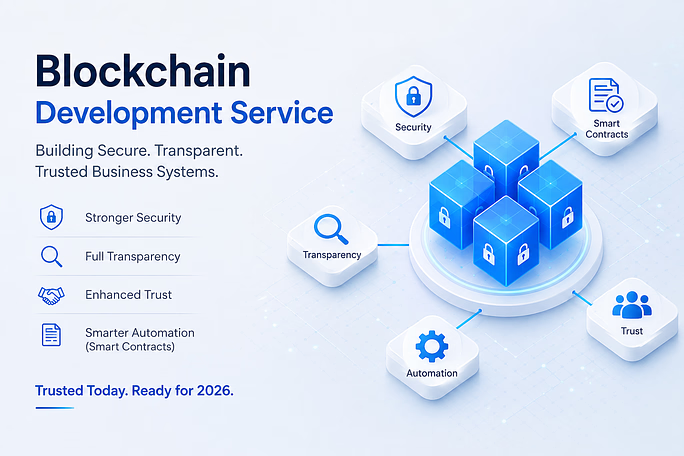
A blockchain development service helps businesses build blockchain-powered systems that improve security, traceability, transparency, and digital trust.
At a simple level, blockchain creates a shared record that can be validated and tracked.
That means businesses rely less on manual checks, disconnected systems, and fragmented data.
These solutions often include:
Smart contracts
Asset tracking
Supply chain visibility
Identity verification
Secure transactions
Data validation
Asset tracking
Supply chain visibility
Identity verification
Secure transactions
Data validation
The goal is not to adopt blockchain for the sake of technology.
The real goal is creating trusted digital operations.
How blockchain improves security
Security is one of the biggest reasons enterprises are moving toward blockchain.
Traditional centralized systems often create a single point of failure.
If one environment is compromised, records can be altered, exposed, or manipulated.
That is where blockchain changes things.
It makes records easier to validate, trace, and audit.
For businesses, that means:
Reduced fraud risk
Stronger audit visibility
Better transaction integrity
Safer digital records
Controlled data access
Stronger audit visibility
Better transaction integrity
Safer digital records
Controlled data access
A reliable blockchain development service helps businesses build this security layer without adding unnecessary complexity.
Transparency becomes easier when everyone works from the same truth
A lot of delays do not happen because people are slow.
They happen because people are looking at different information.
Finance sees one update. Operations see another. Vendors provide separate records.
Now teams stop working and start validating.
That slows decisions.
Blockchain helps solve this by creating one trusted source of truth.
When everyone works from the same validated data, visibility improves. Accountability improves. Decisions move faster.
This becomes valuable in:
Procurement
Supply chain workflows
Healthcare records
Insurance claims
Cross-border operations
Compliance tracking
Supply chain workflows
Healthcare records
Insurance claims
Cross-border operations
Compliance tracking
That is when blockchain starts becoming practical, not theoretical.
Why smart contracts matter in 2026
Many businesses still depend on manual approvals.
And honestly, that is where delays quietly build up.
Payments wait. Contracts wait. Internal workflows pause.
Smart contracts remove some of that friction.
They automatically execute actions when predefined conditions are met.
For example:
A payment is released after delivery confirmation.
A contract activates after approval.
A transfer happens after validation.
A contract activates after approval.
A transfer happens after validation.
This reduces delays, repetitive checks, and dependency on manual intervention.
That is why smart contracts are becoming increasingly valuable in enterprise operations.
Blockchain use cases across industries
Blockchain is no longer limited to fintech conversations.
Businesses across industries are applying it to real operational challenges.
In finance, blockchain enables secure payments, reduces fraud, and verifies transactions.
In healthcare, it protects sensitive records and improves data integrity.
In logistics, it strengthens shipment tracking and chain-of-custody visibility.
In retail, it improves authenticity tracking and supply transparency.
In manufacturing, it supports asset traceability and vendor accountability.
In SaaS and digital platforms, it improves identity management, licensing, and trusted access control.
The trend is clear.
Businesses adopt blockchain when trust gaps create costs, delays, exposure to fraud, or compliance pressure.
How to choose the right blockchain development service
Not every blockchain solution creates business value.
The right blockchain development service starts with business outcomes, not technical hype.
Preferably, ask whether they understand enterprise workflows.
Blockchain should handle genuine issues such as security, transparency, automation, fraud reduction, and traceability.
Then evaluate technical depth.
They should have an understanding of smart contracts, architecture, integration, compliance, and scalability.
Industry understanding matters too.
A blockchain solution for healthcare will not look like one built for logistics or fintech.
And then ask the bigger question.
Are they building for growth?
Blockchain should strengthen long-term infrastructure, not create isolated complexity.
The right partner makes trust simpler, not harder.
Common blockchain implementation challenges
Blockchain is powerful. But implementation is not always simple.
That is why strategy matters before adoption.
One common issue is unclear use cases.
Many businesses adopt blockchain before clearly defining the actual business problem.
Then comes integration.
A strong blockchain development service must connect with ERP systems, payment platforms, cloud tools, and existing databases.
Scalability is another concern.
Enterprise systems need to grow without slowing performance.
Then there is compliance.
Privacy, governance, and regulatory expectations need to be built in early.
A good blockchain development service solves these challenges by designing around business architecture rather than just technology.
Why 2026 is becoming a turning point
Businesses are under pressure from every side.
Cyber risks are rising. Regulations are tighter. Customers expect transparency. Partners want accountability.
At the same time, digital ecosystems are getting more complex.
That is pushing leaders to rethink how trust is built into infrastructure.
A blockchain development service is becoming part of that future-ready strategy.
Businesses investing now are building systems that are:
Secure
Traceable
Scalable
Transparent
Automation-ready
Traceable
Scalable
Transparent
Automation-ready
That creates resilience.
How the right blockchain partner makes the difference
Technology creates value only when it solves the right business problem.
That is why the right partner matters.
A strong blockchain development service starts by understanding workflows, compliance requirements, security gaps, and operational friction.
Then solutions are built around measurable business outcomes.
That is how blockchain moves from experimentation to enterprise value.
This is where Ideas2Goal fits naturally.
By helping businesses create secure, scalable, and trust-led digital systems, blockchain becomes part of smarter long-term growth.
Final thoughts
Trust is getting harder to maintain in fragmented digital environments.
Businesses need systems that improve security, strengthen transparency, and reduce dependence on manual processes.
That is where a strong blockchain development service starts creating real value for enterprises.
It improves visibility.
It supports automation.
It strengthens trust.
And it helps businesses move quickly with more assurance.
If your business involves complex transactions and dealings, compliance-heavy workflows, supply chain visibility, or digital trust challenges, this may be the correct time to rethink how trust is built into your systems.
FAQs
What is a blockchain development service?
A blockchain development service helps businesses build blockchain-powered systems for security, automation, traceability, and trusted digital workflows.
A blockchain development service helps businesses build blockchain-powered systems for security, automation, traceability, and trusted digital workflows.
How does blockchain improve business security?
It improves data integrity, reduces fraud risk, and creates traceable records that are harder to manipulate.
Is blockchain useful beyond finance?
Yes. Blockchain is widely used across verticals such as healthcare, logistics, retail, manufacturing, SaaS, and compliance-heavy industries.
Are businesses investing in blockchain in 2026?
Yes, as digital trust, transparency, automation, traceability, and stronger security are becoming critical business priorities.