Key Trends Shaping the Future of Enterprise Blockchain and Cryptocurrency in 2025

Enterprise Blockchain Solutions
What is enterprise blockchain solutions?
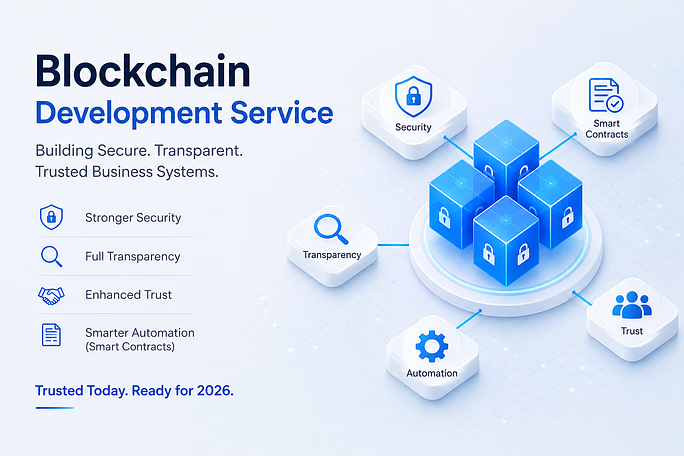
Enterprise blockchain solutions refer to customized blockchain-based technologies designed specifically for businesses and large organizations to streamline operations, enhance transparency, and improve security. Unlike public blockchains such as Bitcoin or Ethereum, enterprise blockchains are typically permissioned networks where only authorized participants can access, validate, or modify data. These solutions are used across various industries—including supply chain, finance, healthcare, and manufacturing—to facilitate trusted data sharing, automate processes through smart contracts, and reduce operational inefficiencies.
By adopting enterprise blockchain solutions, companies can eliminate intermediaries, ensure data integrity, and achieve real-time tracking of assets or transactions. Popular platforms like Hyperledger Fabric, R3 Corda, and Quorum enable businesses to develop tailored blockchain applications that comply with regulatory standards while maintaining control over their data. This makes blockchain not just a technology buzzword but a strategic asset for digital transformation and competitive advantage in the enterprise space.
Blockchain technology and cryptocurrency have experienced exponential growth over the past decade, with 2025 poised to be a pivotal year for the industry. As businesses and governments increasingly adopt blockchain-based solutions, the landscape is evolving rapidly with new trends emerging across industries. From enhanced security protocols to the rise of central bank digital currencies (CBDCs), the future of blockchain and cryptocurrency promises to redefine financial systems, business operations, and data integrity. This article explores the key trends shaping the future of blockchain and cryptocurrency in 2025, with a focus on enterprise blockchain solutions and the growing role of enterprise blockchain development companies.
1. Widespread Adoption of Enterprise Blockchain Solutions
Enterprise blockchain solutions have transitioned from niche applications to essential tools across various industries, including finance, healthcare, supply chain, and manufacturing. Organizations are adopting these solutions to streamline operations, increase transparency, and bolster security measures.
Leading companies are investing heavily in permissioned blockchain networks that provide a secure environment for sensitive business data while allowing for controlled access. Unlike public blockchains, enterprise blockchains offer greater privacy, faster transaction speeds, and improved scalability—making them ideal for business use cases.
Benefits of Enterprise Blockchain Solutions
Enterprise blockchain solutions are transforming the way organizations operate by providing secure, transparent, and efficient digital infrastructures. Below are some of the key benefits:
-
Improved supply chain transparency through real-time tracking:
Blockchain enables all participants in the supply chain to access a single, immutable ledger. This allows for real-time monitoring of goods, verification of authenticity, and faster identification of bottlenecks or fraud. -
Enhanced security and fraud prevention:
With blockchain’s decentralized nature and cryptographic protocols, data tampering becomes virtually impossible. This is particularly valuable in industries like finance, healthcare, and logistics, where data integrity is critical. -
Faster cross-border payments with lower transaction costs:
Blockchain removes the need for intermediaries like banks and clearing houses, resulting in faster transactions and significantly reduced fees. Enterprises operating globally benefit greatly from these efficiencies. -
Reduced reliance on intermediaries:
Smart contracts automate processes and ensure that transactions are executed only when predefined conditions are met. This eliminates the need for third-party verification, reducing costs and delays.
Enterprise blockchain development companies are playing a crucial role in helping businesses design and implement customized blockchain solutions. These companies bring deep technical expertise and industry insights, enabling them to build scalable, secure, and compliant solutions tailored to specific organizational needs.
As more organizations recognize the value of blockchain technology, demand for tailored solutions is expected to grow significantly in 2025. From supply chain optimization and secure identity management to financial services and data sharing, the applications are vast. By investing in enterprise blockchain now, companies can future-proof their operations, gain a competitive edge, and unlock new revenue streams.
Consortium blockchains enable multiple organizations to collaborate on a shared platform, ensuring data consistency and trust among participants. Hybrid blockchain models combine the strengths of public and private blockchains, offering flexibility and control tailored to enterprise needs. These enterprise solutions provide scalable and secure frameworks for various business applications.
In conclusion, enterprise blockchain is no longer just a buzzword—it’s a strategic enabler for digital transformation across industries. Businesses that embrace it early are better positioned to lead in an increasingly decentralized and data-driven world.
2. Rise of Central Bank Digital Currencies (CBDCs)
Governments and central banks worldwide are exploring the introduction of digital currencies backed by state authorities. By 2025, several countries are expected to launch fully functional CBDCs, integrating them into the global financial system.
CBDCs provide greater financial inclusion, enable faster and more secure transactions, and offer central banks greater control over monetary policy. Unlike decentralized cryptocurrencies, CBDCs are centralized and regulated, ensuring stability and reducing the volatility often associated with cryptocurrencies.
Key Developments in CBDCs
Central Bank Digital Currencies (CBDCs) are rapidly emerging as one of the most transformative developments in the global financial ecosystem. Several major economies are leading the charge toward digitizing their national currencies.
-
China’s digital yuan (e-CNY) has already seen widespread adoption in both domestic transactions and select cross-border trade initiatives. The government continues to expand its pilot programs across major cities, with millions of users and merchants participating in digital yuan trials. China is also collaborating with other countries through projects like mBridge, aimed at testing cross-border CBDC interoperability.
-
The European Central Bank (ECB) is advancing plans for a digital euro, with pilot programs expected by 2025. The ECB aims to enhance the efficiency of digital payments within the Eurozone while ensuring financial sovereignty and privacy for users.
-
The U.S. Federal Reserve is actively exploring the feasibility of a digital dollar, focusing on issues related to privacy, monetary policy, and financial stability. While still in the research phase, collaborations with institutions like MIT are paving the way for future development.
Enterprise blockchain development companies are positioned to play a vital role in this evolution by providing the technology backbone for CBDC infrastructure—offering secure, scalable, and compliant platforms that meet central banks’ unique requirements.
3. Tokenization of Real-World Assets
Asset tokenization—the process of converting real-world assets into digital tokens on a blockchain—is gaining momentum. In 2025, asset managers, investment firms, and even governments are expected to tokenize a wide range of assets, including:
- Real estate
- Commodities (e.g., gold and oil)
- Art and collectibles
- Stocks and bonds
Tokenization enhances liquidity, reduces transaction costs, and increases market access by enabling fractional ownership. Investors can buy and trade tokens representing a portion of an asset, increasing participation and democratizing investment opportunities.
Why Tokenization is Transformative:
- Lower transaction fees due to automation through smart contracts
- Increased liquidity in traditionally illiquid markets
- Greater market accessibility for smaller investors
Enterprise blockchain development companies are developing platforms and infrastructure to support large-scale asset tokenization projects, ensuring compliance with regulatory requirements and securing transactions through smart contracts.
4. Decentralized Finance (DeFi) and Institutional Involvement
Decentralized finance (DeFi) has evolved from a niche sector to a major force in the blockchain ecosystem. By 2025, DeFi platforms are expected to handle trillions of dollars in value, attracting institutional investors seeking higher yields and greater transparency.
DeFi platforms enable financial services such as lending, borrowing, trading, and yield farming without relying on traditional banks or financial intermediaries. Built on public blockchains, these platforms use smart contracts to automate processes and reduce the risk of human error.
Key DeFi Trends:
Decentralized Finance (DeFi) continues to evolve rapidly, bringing groundbreaking innovations that reshape the financial services landscape. As DeFi matures, several key trends are emerging:
-
Growth of multi-chain DeFi ecosystems:
Projects are increasingly moving beyond single-chain limitations, leveraging interoperability protocols to facilitate seamless asset and data transfers across different blockchain networks. This trend reduces fragmentation and improves user experience while boosting liquidity and network efficiency. -
Rise of DeFi insurance platforms:
With the increasing value locked in DeFi protocols, the demand for protection against smart contract bugs, exploits, and market volatility is growing. Decentralized insurance solutions are filling this gap, offering peer-to-peer coverage models that help build user trust and mitigate risk. -
Expansion of institutional-grade DeFi products:
Financial institutions and asset managers are now engaging with DeFi via white-label solutions and secure platforms designed to meet compliance requirements. These products often feature enhanced risk management tools, custodial services, and integration with traditional finance systems.
Enterprise blockchain development companies are at the forefront of this transformation, helping traditional financial institutions integrate DeFi protocols into their core systems. These firms ensure compliance with regulatory frameworks, implement robust security practices, and enable scalable infrastructure that bridges the gap between centralized finance and the decentralized world.
5. Enhanced Privacy and Security with Zero-Knowledge Proofs (ZKPs)
Privacy remains a significant concern in blockchain networks. In 2025, zero-knowledge proofs (ZKPs) are expected to play a pivotal role in enhancing privacy and security on both public and enterprise blockchains.
ZKPs allow one party to prove the validity of a statement without revealing any underlying data. This enables secure transactions while preserving user privacy—a critical feature for financial institutions, healthcare providers, and government agencies.
Applications of ZKPs:
- Secure identity verification without revealing personal information
- Privacy-preserving financial transactions
- Encrypted communications in decentralized applications (dApps)
Enterprise blockchain solutions incorporating ZKPs are becoming more sophisticated, providing businesses with secure and compliant data management systems. Companies specializing in enterprise blockchain development are at the forefront of implementing ZKPs into business solutions, ensuring secure and scalable platforms.
6. Integration of Artificial Intelligence (AI) with Blockchain
AI and blockchain are two of the most transformative technologies of the 21st century. In 2025, the convergence of AI and blockchain is expected to unlock new possibilities in data analysis, automation, and decision-making.
Blockchain provides a secure and immutable data layer, while AI algorithms can analyze this data to identify patterns, predict outcomes, and automate processes. This integration creates a powerful synergy: blockchain ensures the integrity and transparency of data, which is essential for training reliable AI models. At the same time, AI enhances blockchain networks by enabling smarter contract execution, fraud detection, and optimized resource allocation.
For example, in supply chain management, AI can analyze blockchain-verified data to forecast demand, optimize inventory, and identify inefficiencies. In finance, AI-driven insights combined with blockchain’s transparent transaction records enable faster fraud detection and improved risk management. Healthcare also benefits as AI processes secure patient data stored on blockchains to personalize treatment plans while maintaining privacy and compliance.
Furthermore, AI-powered automation can streamline blockchain operations by dynamically adjusting network parameters or validating transactions more efficiently. The integration also supports decentralized autonomous organizations (DAOs), where AI can assist in governance decisions based on transparent blockchain data.
Use Cases of AI-Blockchain Integration:
- Fraud detection in financial transactions
- Automated supply chain optimization
- Predictive maintenance in manufacturing
7. Blockchain Interoperability Gains Momentum
As blockchain networks continue to proliferate, the need for interoperability between different chains has become a pressing challenge. In 2025, interoperability solutions are expected to mature, allowing seamless communication and data exchange across diverse blockchain ecosystems.
Interoperability protocols like Polkadot, Cosmos, and Chainlink’s Cross-Chain Interoperability Protocol (CCIP) are paving the way for decentralized applications (dApps) that can operate across multiple chains without friction. For enterprises, this translates to greater flexibility and scalability in deploying blockchain-based systems that connect with partners, suppliers, and customers using different networks.
Why Interoperability Matters:
- Eliminates data silos between blockchains
- Enhances liquidity across decentralized finance platforms
- Enables unified identity management and asset tracking
- Supports cross-industry collaboration and complex supply chain networks
Enterprise blockchain development companies are now building solutions that integrate with multiple chains, using bridges and APIs to streamline multi-network functionality — a key differentiator in a rapidly evolving digital economy.
8. Green and Sustainable Blockchain Solutions
Environmental concerns around blockchain energy consumption — particularly with proof-of-work (PoW) models — have driven demand for sustainable alternatives. In 2025, the focus on green blockchain initiatives will intensify, with enterprises actively seeking eco-friendly blockchain frameworks.
Protocols like Ethereum (now transitioned to proof-of-stake), Algorand, and Tezos are gaining traction for their energy efficiency and scalability. Meanwhile, carbon-neutral blockchain platforms and offsetting mechanisms are being developed to align with ESG (Environmental, Social, and Governance) goals.
Beyond energy-efficient consensus models, innovation is also focusing on reducing the overall carbon footprint of blockchain infrastructure by optimizing hardware, data center efficiency, and network protocols. Many organizations are integrating blockchain with renewable energy projects to create transparent tracking of green energy production and consumption, further incentivizing sustainability.
This growing commitment to eco-friendly blockchain solutions not only addresses environmental responsibility but also helps companies meet regulatory requirements and improve their brand image. Ultimately, green blockchain technologies will play a critical role in enabling sustainable digital transformation for industries worldwide.
Key Sustainability Trends:
- Adoption of low-energy consensus mechanisms (e.g., PoS, DPoS, PBFT)
- Use of blockchain for carbon credit tracking and emissions auditing
- Integration of sustainability reporting tools into blockchain platforms
Enterprise blockchain developers are responding by designing energy-efficient architectures and supporting clients in meeting compliance standards while reducing their environmental impact. This will be essential as governments and investors increasingly prioritize sustainability metrics.
9. Expansion of Blockchain-as-a-Service (BaaS)
The demand for rapid deployment of blockchain solutions without complex infrastructure has led to the rise of Blockchain-as-a-Service (BaaS) platforms. In 2025, more enterprises will turn to BaaS offerings from major providers like Microsoft Azure, Amazon Web Services (AWS), and IBM Blockchain to accelerate time-to-market and reduce technical overhead.
BaaS allows businesses to experiment, scale, and innovate without managing the backend complexity. As a result, enterprise blockchain development companies are partnering with cloud service providers to offer turnkey solutions that are secure, scalable, and compliant.
Enterprise blockchain development companies are at the forefront of creating AI-enhanced blockchain platforms, implementing enterprise blockchain technologies for supply chain management, trade finance, business processes, and digital assets. By leveraging frameworks like Hyperledger Fabric and private blockchains, these solutions enhance transparency and security while enabling efficient data sharing across existing systems. Integration with current infrastructures ensures minimal disruption and maximum compatibility.
With Practical Byzantine Fault Tolerance (PBFT), businesses can achieve robust and reliable consensus mechanisms. This technology enables seamless management blockchain solutions, optimizing workflows, enhancing trust, and driving innovation across industries.
Conclusion
The future of blockchain and cryptocurrency in 2025 is set to be defined by increased institutional adoption, enhanced privacy protocols, and innovative applications in finance, supply chain, and beyond. Enterprise blockchain solutions will play a central role in this transformation, with enterprise blockchain development companies driving the creation of scalable, secure, and compliant platforms.
As businesses and governments embrace blockchain technology, staying ahead of these trends will be crucial for competitive advantage. Companies that strategically invest in blockchain infrastructure, asset tokenization, blockchain programming, and DeFi integration will be well-positioned to thrive in the evolving digital economy. The future of blockchain is not just about technology—it’s about creating a more secure, transparent, and efficient global system.
FAQs
1. What are enterprise blockchain solutions and how do they support cryptocurrency adoption?
Enterprise blockchain solutions provide secure, permissioned networks that enable businesses to leverage blockchain for managing transactions, asset tokenization, and smart contracts. They facilitate controlled cryptocurrency adoption by integrating digital assets within existing enterprise systems.
2. What industries are using enterprise blockchain and cryptocurrencies in 2025?
In 2025, industries like finance, supply chain, healthcare, real estate, and energy are harnessing enterprise blockchain and cryptocurrency for streamlined payments, enhanced traceability, decentralized finance (DeFi) offerings, and improved data security.
3. How do businesses ensure regulatory compliance when using enterprise blockchain and cryptocurrencies?
To ensure compliance, businesses implement identity verification (KYC/AML) protocols, maintain transaction audit trails, adhere to local regulations for digital assets, and apply encryption/security standards. Enterprise blockchain platforms support built-in compliance features and permissioned access for regulatory oversight.
4. What are the main challenges of integrating cryptocurrency with enterprise blockchain systems?
Common challenges include regulatory uncertainty, scalability and network performance, security risks, and the complexity of integrating with legacy enterprise systems. Overcoming these challenges requires detailed planning, secure smart contract audits, and working with experienced blockchain providers.
5. What benefits can enterprises expect from combining blockchain and cryptocurrency in 2025?
Key benefits include faster, lower-cost cross-border transactions, greater transparency and traceability, secure asset tokenization, enhanced data integrity, and access to new financial models through decentralized finance (DeFi) and smart contracting.